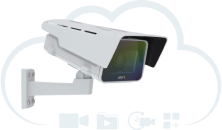
IP Camera
What is an IP camera?
An IP camera (or network camera) is a type of camera that uses an internet protocol (IP) for video transmission. In order to process an image and broadcast it in digital form, you’ll need an internet connection, a camera, and an encoder, which modifies the signal sent by the camera so it is readable to the majority of end devices. The end user can watch live video on his/her PC, tablet, or mobile phone or watch a recording of the footage later.
IP camera sets and systems are an important element of security systems and are used to monitor the interiors and premises of buildings. Thanks to the increasing quality of video recording and transfer, these cameras are being used more and more often as an affordable solution to live broadcasting (streaming) cultural, sporting, and other events.
Placement and purpose of camera use
Indoor IP cameras (interior) – these cameras are made for indoor use and are not generally equipped with protection against poor weather conditions such as rain or dusty conditions.
Outdoor IP cameras (external) – as the name implies, these cameras are suitable for outdoor monitoring. Because these cameras are built directly into their casings and have a durable hardware design, they are (to varying degrees) resistant to the outdoor elements. The most durable cameras can record images even in extreme conditions.
Spy IP camers (camouflaged) – for security and spying purposes, these internal and external cameras are often camouflaged as common objects such as a bird house, bird feeder, or a service box for an electrical system. Miniature IP cameras can even fit into objects like a pen, light bulb, or a digital watch.
Connecting and powering the camera
Wi-Fi IP cameras – these cameras are connected to the internet via a WiFi network. A disadvantage of this type of camera is the limited space for installation, as it is dependent on the WiFi network’s coverage, potential signal fluctuations that affect the quality of transferred data, and the necessity to have a power cable. Power can also be provided by certain types of storage cells (batteries, power banks), but for live streaming, for example, these power sources are still inadequate.
IP cameras with a LAN cable – this type of camera guarantees a stable and speedy transfer of graphic data. Power is most commonly provided via a “PoE” (Power over Ethernet) injector, which powers the camera via a UTP cable.
IP cameras with an alternative connection and power supply – the market also offers solar-powered IP cameras or cameras that are connected to the internet via a mobile router, today most commonly using the LTE service, which contains a SIM card or combines multiple SIM cards from various operators.
IP camera resolution
Generally speaking, the higher the camera’s resolution, the more detailed and “better” the image. This is important both for security cameras and the quality of live streams such as sporting events. The standard resolution of today’s IP cameras is HD 1280x720 and Full HD 1920x1080. Devices with higher resolution are also naturally offered on the market, such as 4K Ultra HD IP cameras with a resolution of 3840×2160.
Night monitoring
Security cameras are commonly equipped with a night mode. When activated, the device switches to black and white recording. In order to achieve a quality image in this mode, these cameras use IR (infrared) technology that allows the camera to sufficiently illuminate the scene being recorded. Infrared emissions are invisible to the human eye so there is no risk of undesired glare or the camera being detected. Axis cameras also use the WDR function, which suppresses dark areas of the image by brightening them.
Camera rotation and zoom
In addition to static IP cameras with a fixed viewing angle, PTZ cameras (pan-tilt-zoom) are also available. These cameras’ motion and zoom can be controlled remotely. The camera can be panned or tilted in a selected direction or zoomed in on a scene according to a human command or a pre-selected program.
Video recording
Most IP cameras send the recorded video to external storage where the recording is backed up. Other cameras also come equipped with an SD card slot. Video can thus be recorded up to a certain size directly onto the card. This option is an advantage especially for security cameras in the event of a network failure or in any other situation where you want to be sure you don’t lose the video. If you’re not recording directly to the camera’s SD card, recording from the camera isn’t as simple as it might seem. If you are using a service like Facebook to stream, you can only save video with a maximum period of 4 hours before the end of the stream. YouTube’s Stream Now service records the whole event. In order to store data outside a streaming service, you’ll need to use either local server storage or, if you’re using NetRex’s services, cloud storage that saves data via an internet connection.
Manufacturers and brands of IP cameras
A whole score of companies develop and produce IP cameras. The oldest of all these companies is Sweden’s Axis Communications, whose founder Martin Gren invented the first IP camera in 1996. The following brands of IP cameras are the most common: